Staff at the U.S. Securities and Exchange Commission said they would not recommend enforcement action if biotech platform Molecule sold its research tokens without registering the offering, provided the sale followed the terms Molecule described in its request. The no-action letter, reported by Eleanor Terrett on November 24, 2026, applies to those specific facts. It does not give other token-funded research projects blanket approval.
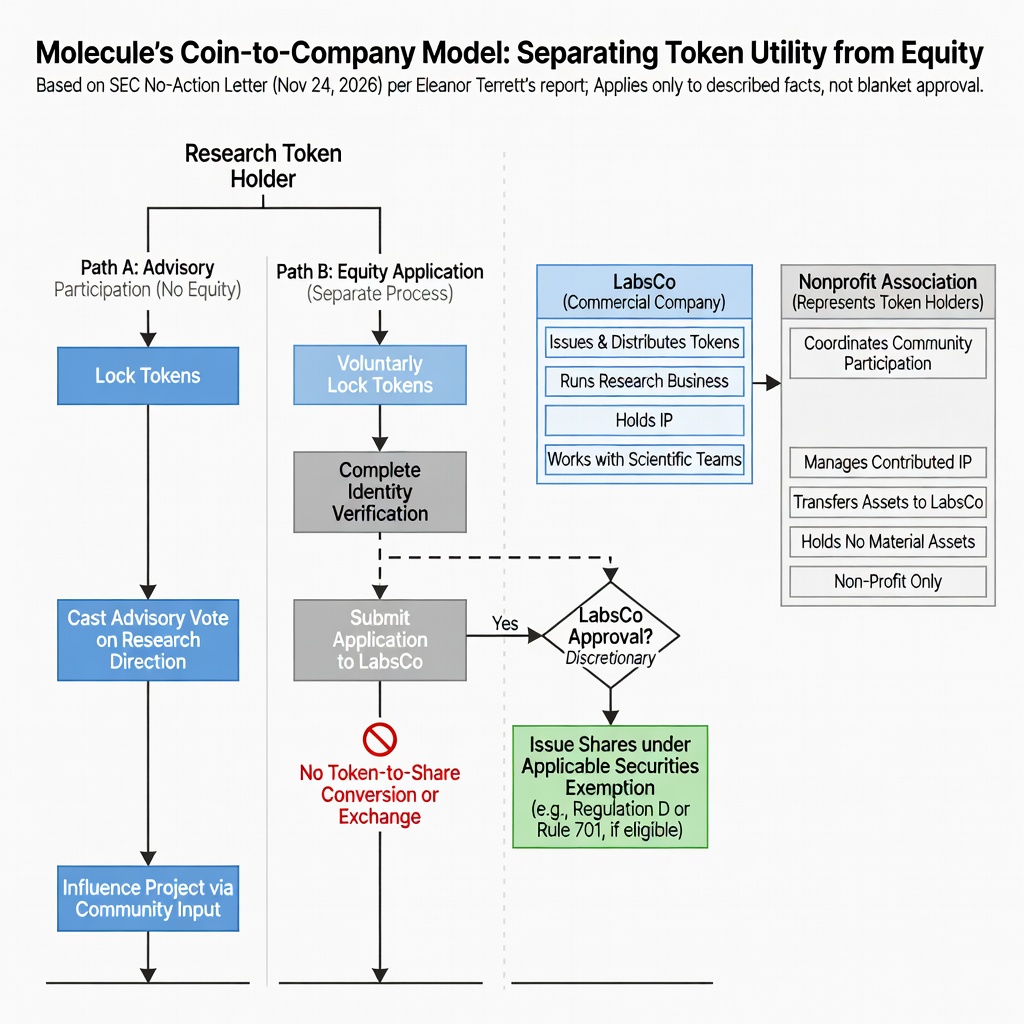
Molecule’s Coin-to-Company model lets communities fund scientific research without giving token holders an ownership stake or other financial interest in the company conducting it. Holders can lock tokens to cast advisory votes on the direction of a project. Applying for shares is a separate process.
How participation differs from ownership
According to Molecule, each project has a commercial company, called LabsCo, and a nonprofit association representing token holders. LabsCo issues and distributes the tokens, runs the research business, holds intellectual property and works with scientific teams. The association coordinates community participation, manages contributed intellectual property and transfers relevant assets to LabsCo. It holds no material assets and does not operate a for-profit business.
A holder who wants shares can voluntarily lock tokens, complete identity verification and apply to LabsCo. The company decides whether to approve the application. If it does, it can issue shares under an applicable securities exemption, such as Regulation D or Rule 701, depending on eligibility. The locked tokens neither convert into shares nor serve as payment for them.
Molecule said the letter reduced regulatory uncertainty for its funding model and could help attract institutional investors seeking clearer legal arrangements for early-stage research. As of November 25, 2026, the company expected the first project in its ecosystem to adopt the model in the following weeks.