
Originally reported November 11, 2026, at 05:34 UTC+8.
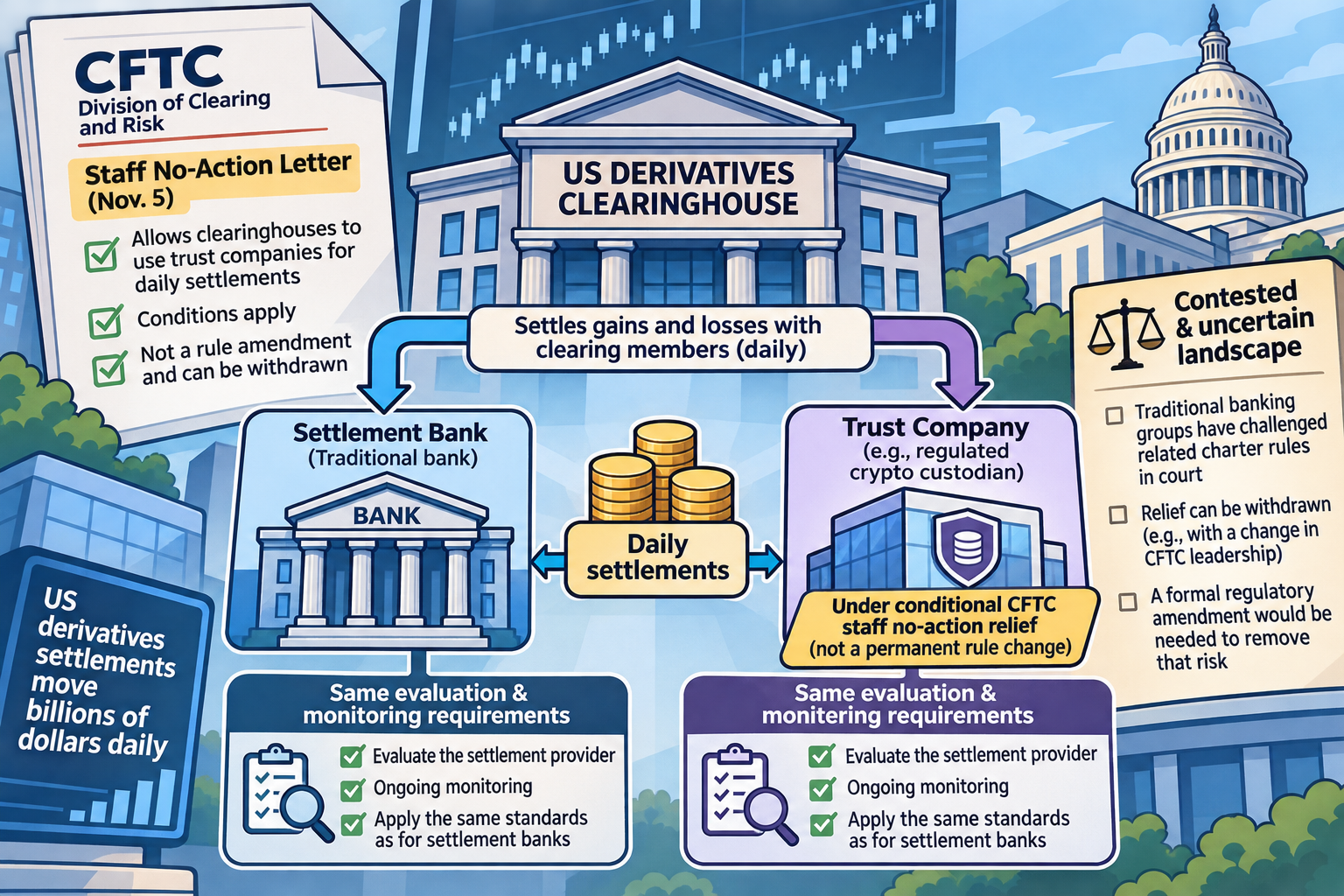
US derivatives clearinghouses may use trust companies for daily settlements with clearing members under conditional relief issued by the Commodity Futures Trading Commission’s Division of Clearing and Risk on November 5. The decision creates a potential role for regulated crypto custodians in a service that CFTC regulations had restricted to banks, but it does not permanently change those regulations.
The relief followed an October 29 request from clearinghouse Nodal Clear. Clearinghouses using trust companies must apply the same evaluation and monitoring requirements used for traditional settlement banks. The decision addresses a mismatch: federal commodities law permits customer funds to be held at banks or trust companies, while CFTC Regulation 39.14 defines settlement banks only as banks.
The sums moving through settlement infrastructure are substantial, though they are not revenue for settlement providers. CME Group reported an average of $8.7 billion transferred between clearing firms per business day in the first half of 2026 to settle gains and losses, compared with $6.7 billion a day in 2025.
Nodal Clear partnered with Coinbase in 2025 to integrate USDC into US futures trading. Cointelegraph reported that Coinbase Custody Trust was already expected to provide daily settlement services under that arrangement. Separately, Coinbase National Trust Company’s national trust bank charter took effect on November 6, permitting that distinct entity to provide federally supervised digital-asset custody services.
The expansion of trust companies’ roles remains contested. In October, the Independent Community Bankers of America sued the Office of the Comptroller of the Currency, arguing that its charter rules could let crypto firms undertake certain banklike activities without all the requirements conventional banks face. Cody Carbone, CEO of The Digital Chamber, told Cointelegraph that the CFTC relief gives clearinghouses more options without putting trust companies ahead of banks or excluding banks from the business.
The CFTC action is a staff no-action letter, not a rule amendment: staff said they would not recommend enforcement action when its conditions are met, but the letter can be withdrawn. Jordan Yeagley, a shareholder at Buchanan Ingersoll & Rooney, told Cointelegraph that a change in Commission leadership could lead to its withdrawal and that a formal regulatory amendment would be needed to remove that risk. At the time of the original report, CFTC Chair Michael Selig was the agency’s sole commissioner, with four seats vacant.
Source: cointelegraph.com (originally published 2026-11-11 05:34 UTC+8)