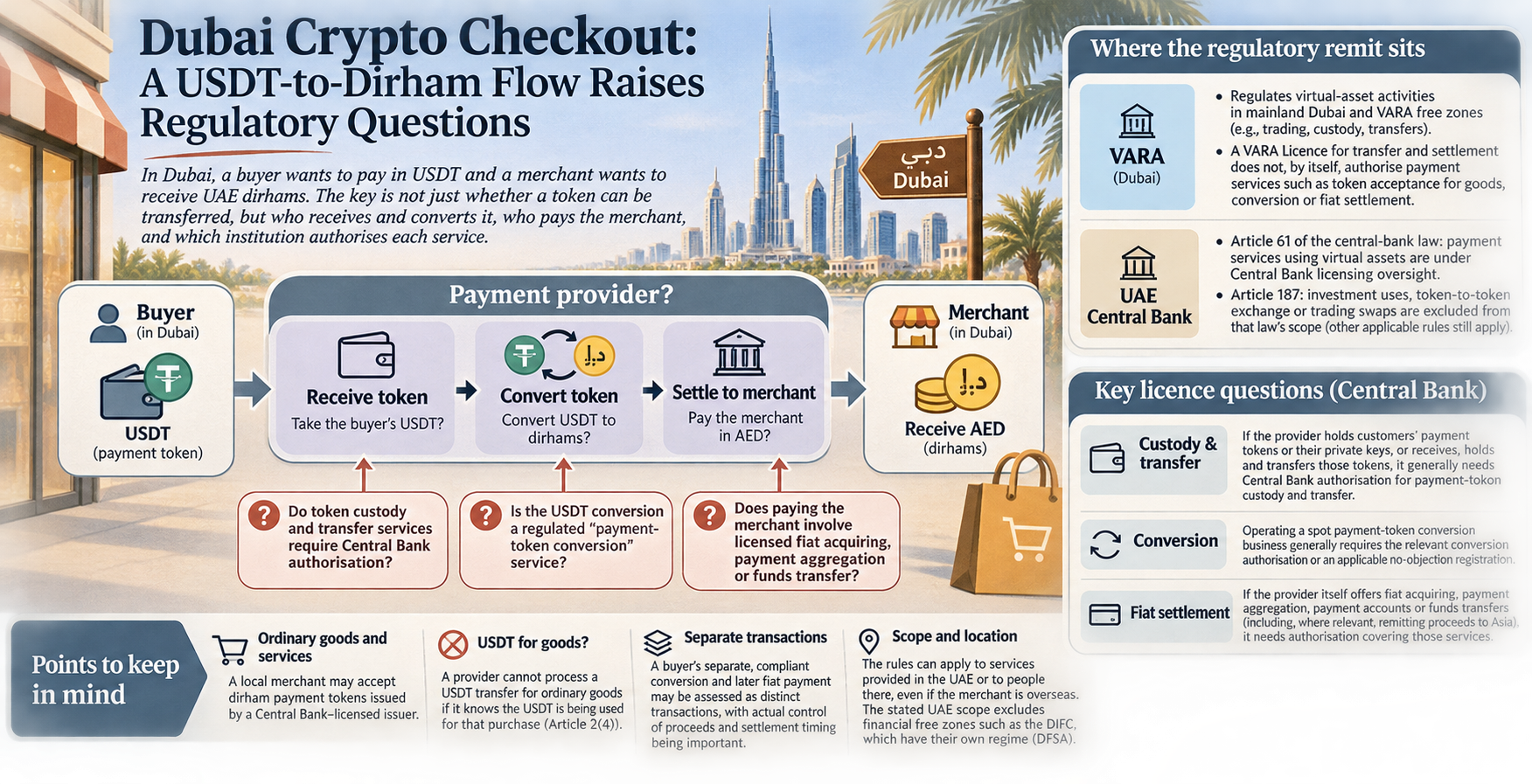
Originally reported on 11 November 2026 at 13:53 (UTC+8). In an analysis for Mankun Blockchain Legal Services, Shao Jiadian examines a Dubai checkout scenario: a buyer wants to pay in USDT, while the merchant wants to receive UAE dirhams. The central question is not simply whether the payment provider can transfer a token. It is who receives and converts it, who pays the merchant, and which institution authorises each service.
Where VARA’s remit ends
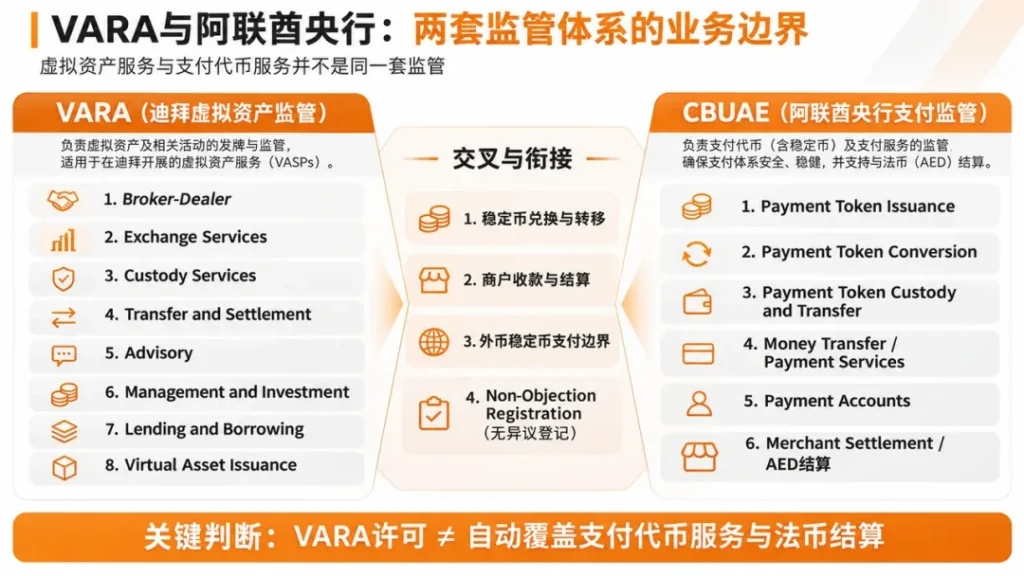
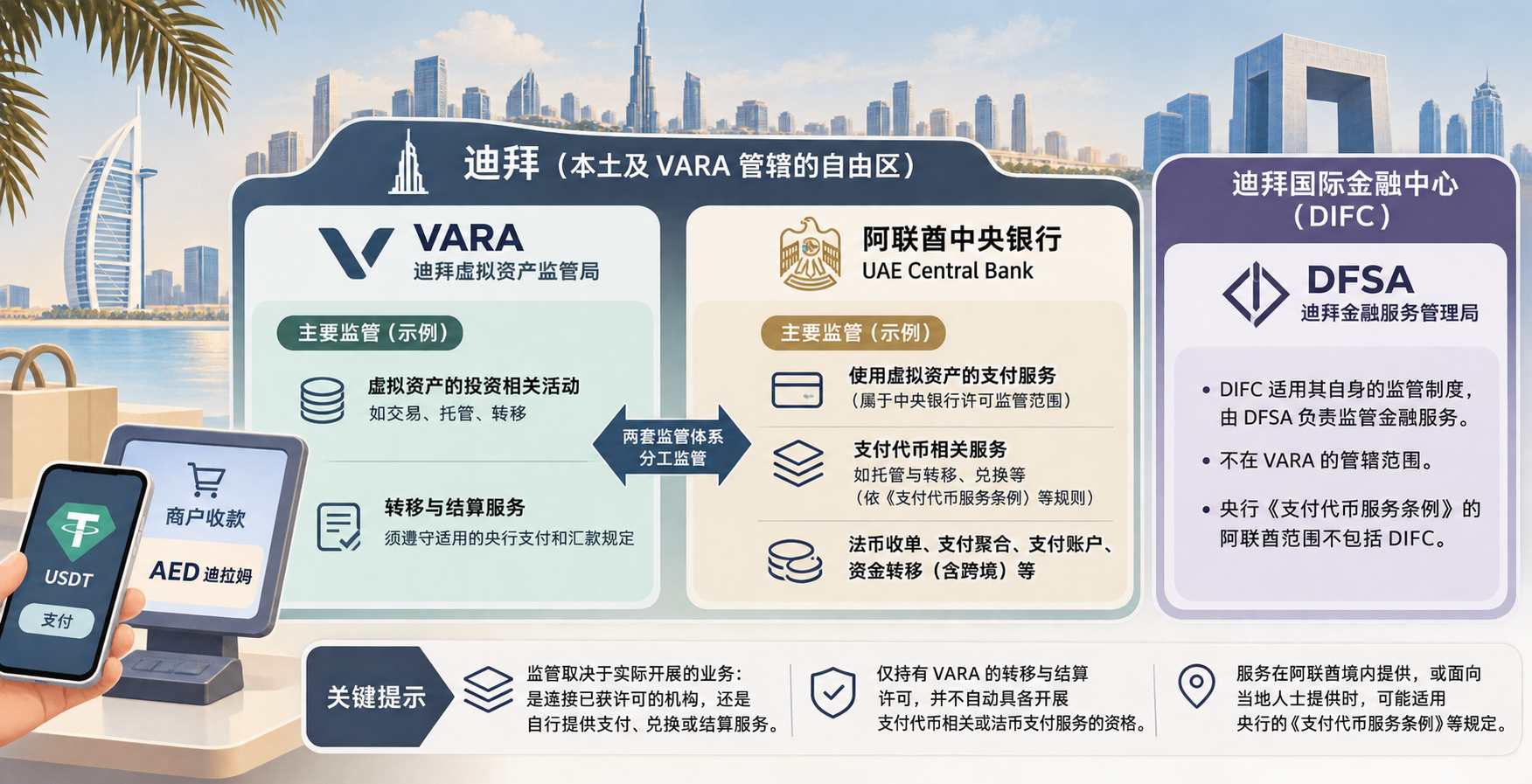
In mainland Dubai and free zones under the Virtual Assets Regulatory Authority (VARA), investment-related virtual-asset activities and payment services are not interchangeable. Trading, custody and transfers each require the relevant VARA authorisation. An institution dealing only in non-payment tokens for investment, token-to-token trading and related services does not need a central-bank payment authorisation solely for those activities, according to the analysis.
The UAE central-bank law that took effect on 16 September 2025 distinguishes the two areas. Article 61 places payment services using virtual assets within central-bank licensing oversight; Article 187 excludes virtual assets used for investment, token-to-token exchange or trading swaps from that law’s scope, while leaving other applicable rules in place. VARA’s transfer-and-settlement rules, effective from 19 June 2025, also require compliance with applicable central-bank payment and remittance rules. Cross-border transfers must be lawful in each jurisdiction involved.
Can USDT pay for ordinary goods?
Under Article 2(7) of the central bank’s Payment Token Services Regulation, a local merchant accepting tokens for ordinary goods or services may accept dirham payment tokens issued by a central-bank-licensed issuer. Foreign-currency payment tokens issued by a registered issuer are limited under that provision to purchases of virtual assets or their derivatives.
The analysis says a payment-token service provider cannot evade that distinction by taking USDT from a buyer for ordinary goods, converting it and settling dirhams with the merchant. Article 2(4) bars a licensed or registered provider from processing the transfer when it knows the USDT is being used for that purchase. A buyer’s separate conversion through a compliant channel, followed by payment with fiat under the buyer’s control, must instead be assessed as separate transactions; the actual control of the proceeds and timing of settlement matter.
The article contrasts two Dubai examples without treating them as equivalent. In September 2026, Network International piloted checkout using DDSC, a dirham payment token from a central-bank-licensed issuer, at a Marks & Spencer store in Dubai Festival City. In August 2026, Dubai Duty Free introduced Crypto.com Pay for eligible UAE residents, with merchants receiving dirhams. The provider, Foris DAX Middle East FZE, held both a VARA virtual-asset licence and a central-bank stored-value facility licence. The Dubai Duty Free announcement did not disclose which asset was debited in each transaction or the full conversion and funds flow.
Licences depend on the work performed
The Payment Token Services Regulation has applied since 31 August 2024. A provider that itself holds customers’ payment tokens or relevant private keys, or receives, holds and transfers those tokens for customers, generally needs central-bank authorisation for payment-token custody and transfer. Operating a spot payment-token conversion business likewise requires the relevant conversion authorisation or an applicable no-objection registration. The analysis says a VARA transfer-and-settlement licence alone does not qualify an institution for either registration route; eligibility and central-bank approval must be assessed separately.
Dirham settlement raises another question. If the provider itself offers fiat acquiring, payment aggregation, payment accounts or funds transfers—and, where relevant, sends proceeds to Asia—it needs authorisation covering those services. An appropriately authorised bank or payment institution can instead contract directly with the merchant and handle the funds. Merely using a bank account does not transfer the provider’s regulatory responsibilities to the bank if the provider contracts for, collects, forwards and refunds merchant payments itself.
The regulation can apply to payment-token services provided within the UAE or to people there, even where a merchant is overseas. Its stated UAE scope excludes financial free zones such as the Dubai International Financial Centre (DIFC). VARA also does not regulate the DIFC; financial services there fall under its own regime overseen by the Dubai Financial Services Authority.
The practical distinction is therefore between connecting a merchant to separately authorised providers and operating the payment, conversion or settlement service oneself. A VARA transfer licence does not, by itself, answer every part of a USDT-to-dirham checkout flow.
Source: techflowpost.com (originally published 2026-11-11 13:53 UTC+8)