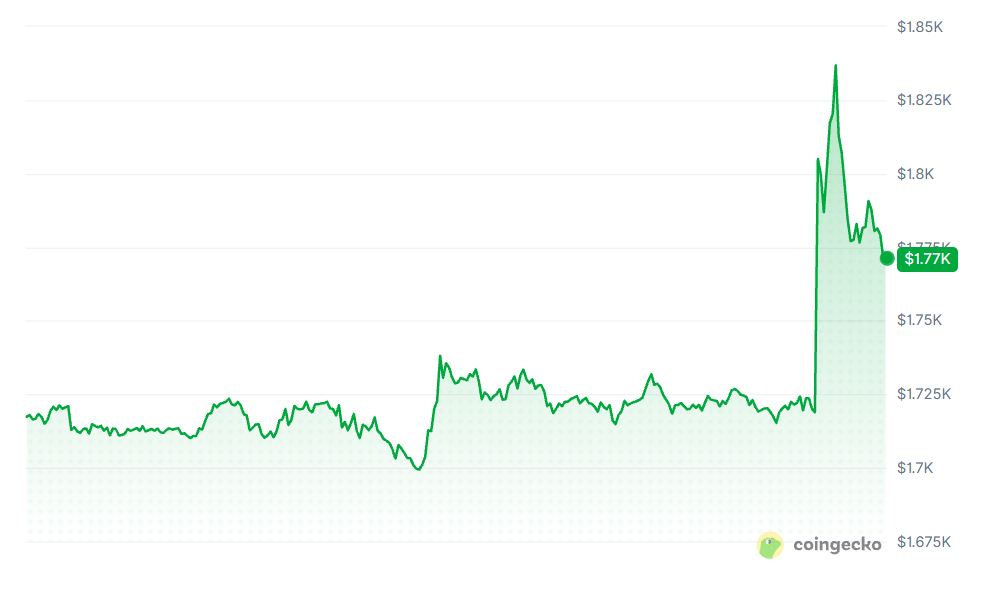
Ethereum traded back above $1,700 on November 23, 2026, after falling to around $1,539 over the weekend. The rebound reached $1,845.07 during Monday’s session before ETH retreated to about $1,783.80, according to Binance ETH/USDT data cited by crypto.news. It had also traded as low as $1,696.50 earlier that day.
The recovery followed a roughly 7.6% decline on Friday. Although ETH briefly moved above $1,826—a resistance level identified by market commentators—it had not sustained that move by the time of the report.
US spot Ethereum ETFs record five days of outflows
Farside Investors data showed approximately $305.8 million in net outflows from US spot Ethereum ETFs across all five trading sessions from November 16 through November 20. Thursday’s $131.2 million and Friday’s $97.3 million accounted for roughly three-quarters of the total.
BlackRock’s iShares Ethereum Trust recorded $124.2 million in outflows on Thursday and another $60.8 million on Friday. Friday’s figures also included $15.9 million from Fidelity’s FETH and a combined $13.2 million from Grayscale’s two Ethereum funds. ETF flows are one measure of demand, but they do not determine ETH’s price on their own.
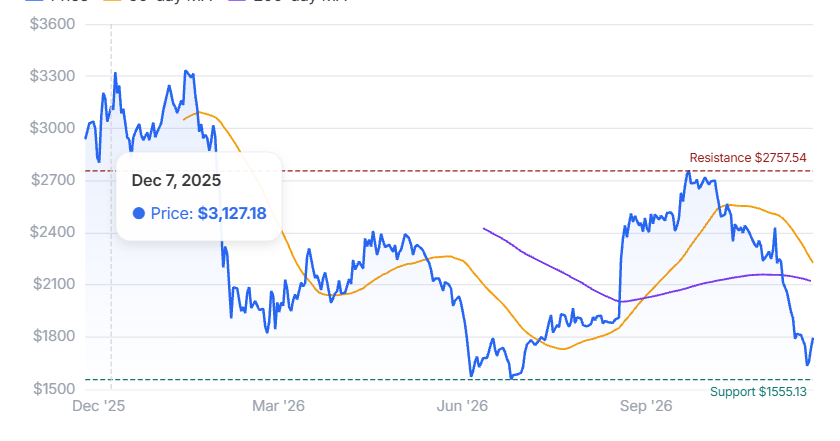
Momentum improves, but longer-term indicators remain weak
ETH’s 14-day relative strength index rose from 22.63 on Friday to 35.37 on Monday, moving above the level of 30 commonly described as oversold. That improvement did not, by itself, establish a broader reversal: ETH remained below the midpoint of its daily Bollinger Bands, near $1,953.24, and below its 20-week and 50-week simple moving averages, near $2,222.60 and $2,226.12.
A seven-day CoinGlass heatmap indicated potential liquidation concentrations around $1,825–$1,850, as well as around $1,770 and just below $1,700. These are estimates of where leveraged positions may be vulnerable, not a prediction that liquidations will occur. As of the November 23 report, ETH had recovered from its weekend low but had not held above the resistance area it briefly crossed.
