
Robinhood has added its first Stock Token linked to an actively managed exchange-traded fund, giving eligible users economic exposure to the Nasdaq-listed T. Rowe Price Technology ETF (TTEQ) on Robinhood Chain. The token is a debt security issued in Jersey, not a share of the fund. This account follows reporting published on November 24, 2026, and does not describe any later change.
What Robinhood added
Robinhood Crypto said in a November 23, 2026 post that actively managed ETFs had been added as a category within Stock Tokens. The first entry is tied to TTEQ, a technology fund that debuted in October 2024.
Stock Tokens are tokenized debt securities issued and operated by Robinhood Assets (Jersey) Limited. They are meant to provide economic exposure to an underlying ETF or other asset, not ownership of it. Robinhood has said the token is not an investment in T. Rowe Price.
The listing follows an October announcement in which Robinhood Crypto said it was exploring a token tied to an active ETF alongside T. Rowe Price’s digital assets team. That October statement was an exploration, not the product later listed. In the November post, Robinhood said T. Rowe Price does not issue, sponsor, endorse, or recommend Robinhood Stock Tokens.
Where the token is restricted
The offering is not available in the United States or to U.S. persons. Robinhood listed Austria, Denmark, Estonia, Hungary, and Sweden as markets where the TTEQ token is unavailable. It pointed users to its jurisdiction list for other restrictions, including those affecting Canada, the United Kingdom, and Switzerland. Those further entries are restrictions Robinhood referred to a list for; the company did not describe them as identical to the five named European exclusions.
U.S. customers can find the underlying ETF on Robinhood’s U.S. brokerage platform. The Jersey-issued token is subject to separate offering terms, which restrict sales and delivery in the United States and to U.S. persons.
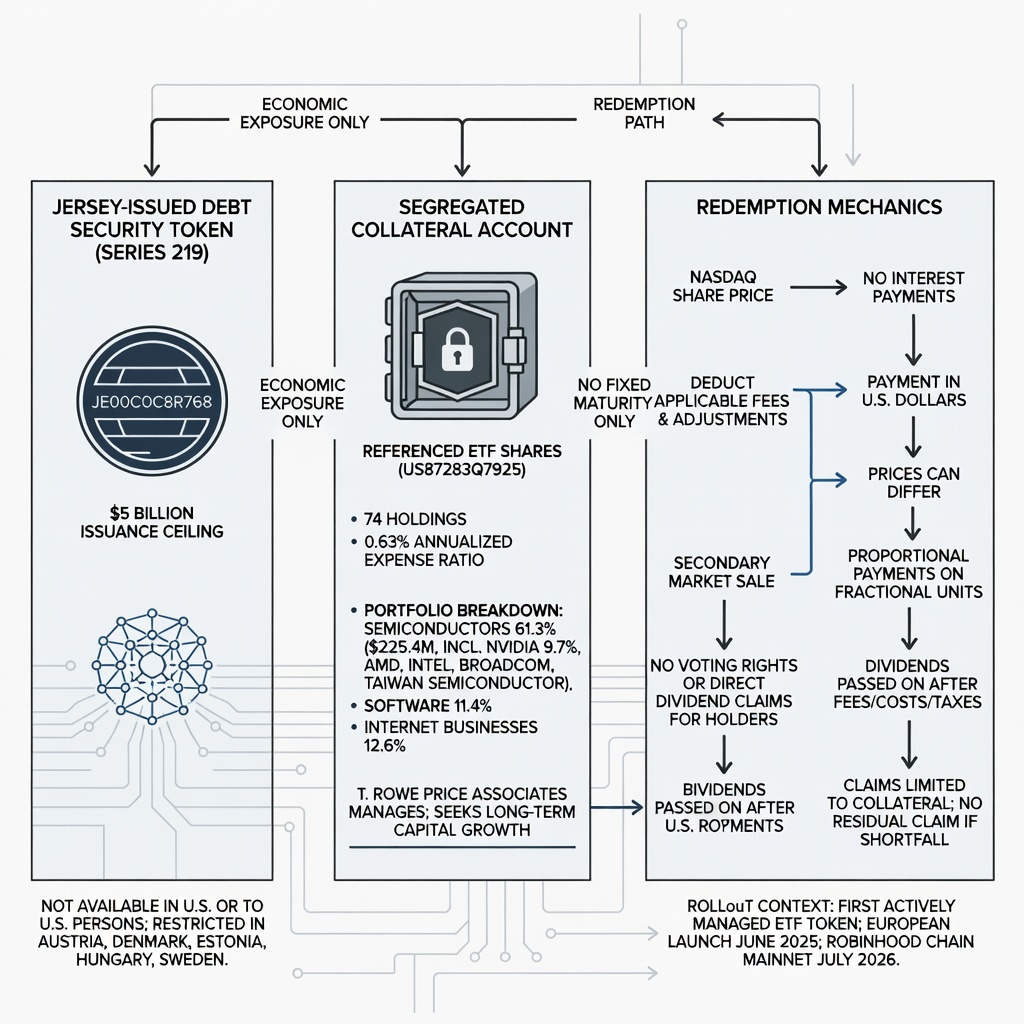
Terms of the Jersey security
Final terms dated November 20 from Robinhood Assets (Jersey) Limited identify the dollar-denominated token as Series 219 of its debt securities program. The token carries the international securities identifier JE00C0C8R768. The ETF shares it references carry a separate identifier, US87283Q7925.
The terms set a $5 billion issuance ceiling for the series and allow the issuer to raise it. The securities have no fixed maturity date and pay no interest.
For a redemption equivalent to one ETF share, the issuer starts with the share price on Nasdaq and deducts applicable fees and other adjustments. Payment is made in U.S. dollars, and the amount can differ from the price a holder gets by selling the token on the secondary market. The terms provide for proportional payments on fractional units.
The terms say the ETF shares make up the primary collateral for the issuer’s payment obligations, with cash or other eligible instruments permitted under specified conditions. The shares are held in a segregated account. If enforcement becomes necessary, holders’ claims are limited to the collateral allocated to their series. They have no residual claim against the issuer if selling that collateral leaves a shortfall.
Holders have no voting rights in the fund and no direct claim to dividends from the fund itself. If the issuer receives a dividend or similar payment on the ETF shares, the terms require it to pass on the benefit after applicable fees, costs, and taxes.
What the referenced fund reported
T. Rowe Price’s shareholder report shows that the fund ended June with 74 holdings and an annualized expense ratio of 0.63%. Semiconductors made up 61.3% of the ETF in June, about $225.4 million of the portfolio. Nvidia alone made up 9.7% of net assets, and the fund’s holdings included AMD, Intel, Broadcom, and Taiwan Semiconductor Manufacturing. The same filing put software at 11.4% and internet businesses at 12.6% as of June 30.
The fund seeks long-term capital growth. According to the fund description in the final terms, it normally invests at least 80% of net assets, plus any investment borrowings, in companies it expects to earn most of their revenue from technology or from businesses enabled by it. T. Rowe Price Associates manages the portfolio, and the fund’s board renewed its advisory agreement in March.
The filing puts portfolio turnover at 15.7% for the six months through June. T. Rowe Price Group and its wholly owned subsidiaries together held 575,000 fund shares at the end of that period, representing 7% of net assets.
Those figures describe the underlying ETF in the cited report. They are not token prices and do not state what a token holder would receive.
Place in Robinhood’s stock-token rollout
Robinhood’s European Stock Tokens launch in June 2025 covered more than 200 U.S. stocks and ETFs, with the tokens initially running on Arbitrum. When Robinhood opened its own network in July 2026, it kept the first-generation products in the Robinhood Europe app under the name Classic Stock Tokens.
Earlier reporting said that when Robinhood Chain mainnet opened, eligible users in more than 120 countries could access the newer generation of Stock Tokens through Robinhood Wallet. The company’s chain documentation says market makers can create or redeem tokens within a weekday window, while users can still trade onchain outside that window. Uniswap was one of the exchanges available from the network’s first day. In August, Uniswap founder Hayden Adams said the platform had passed $1 billion in cumulative tokenized stock trading on Robinhood Chain.
The TTEQ product is the first Stock Token Robinhood has tied to an actively managed ETF. On the terms described above, it remains a Jersey debt security: economic exposure rather than fund ownership, collateral limited to the relevant series, and availability set by the stated offering restrictions.